Amber Isn't Automatically Fine: Reading Dashboard Warnings on a Used-Car Test Drive

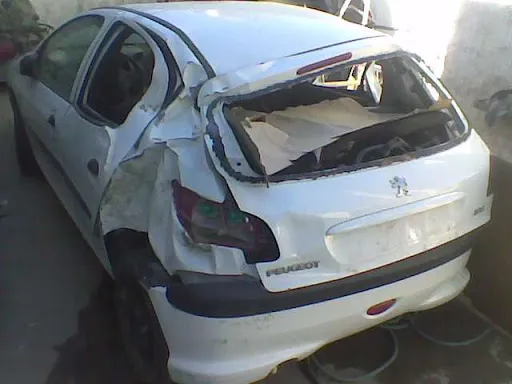
Photo: Biswarup Ganguly, CC BY 3.0, via Wikimedia Commons
You turn the key, the dash does its little Christmas-tree routine, and one light stays on. The seller spots your face and says the words every used-car buyer eventually hears: "That's just a sensor, mate. They all do that."
Sometimes they're right. Often they're not, and the difference between the two can be a £40 lambda sensor or a £1,400 gearbox. Here's how we'd read a dashboard on a test drive, in plain English, without either panicking or being fobbed off.
Start with the bulb check — it's free information
Before the engine fires, watch what happens when you turn the ignition on. Every warning light should illuminate briefly and then go out. That self-test is doing you a favour twice over.
If a light never comes on at all — particularly the engine management light or the airbag light — be suspicious. Someone may have removed the bulb or taped over the LED to hide a fault. It sounds like a myth until you've seen it. A dashboard that doesn't do the full sweep is a dashboard telling you a story.
Also, check the car is actually cold when you arrive. A seller who has "just warmed it up for you" has robbed you of the most revealing thirty seconds of the whole viewing.
The reds: stop, don't negotiate
Red means stop. On a test drive, that's literal.
- Oil pressure (the oil can). If this stays lit once the engine is running, switch off as soon as it's safe. Low oil pressure can destroy an engine in minutes. It might be a failing sender — it might be a knackered pump and a bottom end full of swarf.
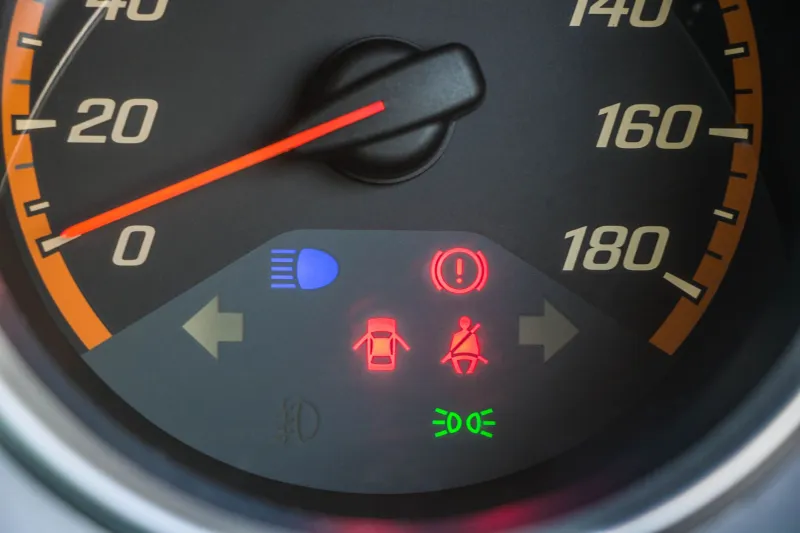
- Brake warning (the circle with an exclamation mark). Could be low fluid, could be a seized caliper, could be the handbrake left on by the previous driver. Either way, don't drive far and don't drive briskly.
- Coolant temperature (the thermometer, usually red). Overheating on a test drive is a walk-away in most cases. Head gaskets don't un-blow themselves.
- Battery/charging (the rectangular battery symbol). A red charging light usually points at the alternator or the belt. On a modern car with electric power steering, a dying alternator can leave you with no assistance mid-corner.
If any of these appear, pull over, note the mileage and the exact light, and end the drive. You're not being dramatic — you're being sensible.
The ambers: negotiate, don't ignore
Amber is where most deals live or die, and where sellers get the most creative.
Engine management light (EML). The classic. It can mean a loose fuel cap, a lazy oxygen sensor, a misfire, a blocked EGR valve or a catalytic converter on its last legs. The light itself tells you nothing — only a fault code read does. On a diesel, an EML alongside a DPF warning is a genuine reason to pause: town-driven diesels clog filters, and a forced regeneration isn't always the end of it.
ABS and traction control. Often a wheel speed sensor, which is cheap. Sometimes an ABS pump, which absolutely isn't. You can test the basics yourself: find a quiet, empty stretch and brake firmly from about 20mph. You should feel the pedal pulse. If the light comes on mid-drive rather than at startup, that's more telling than one that's permanently lit.
Airbag/SRS. Frequently a connector under the seat — a known weakness on plenty of mainstream cars. But it's also an MOT talking point, and you can't verify it with a glance.
AdBlue and glow plug lights on diesels. Both are common, both are fixable, neither is free. A flashing glow plug light on some VAG cars can indicate more than glow plugs.
Tyre pressure (TPMS). Since 2015, TPMS faults are an MOT fail. A light here might just be a soft tyre from standing, or it might be a dead sensor in a wheel — around £40–£80 each to replace.
"It's just a sensor" — how to handle it politely
You don't need to argue. You need to make the sentence testable.
Try: "Fair enough — if it's just a sensor, would you mind if we plug a code reader in before I decide? Takes two minutes." A seller with nothing to hide says yes. A seller who suddenly has somewhere to be has told you something useful without saying a word.
A basic OBD-II reader costs about £20 and lives in the glovebox of anyone who's bought a used car before. It gives you the code, not the cause — but a code plus a cold start plus a five-mile drive is a decent picture. If the codes have been recently cleared, you'll often see "not ready" monitors, which is its own red flag.
Record it before you talk price
If you decide to proceed, don't rely on memory or goodwill.
- Photograph the lit dashboard with the odometer visible.
- Film a short clip of the cold start, so the light's behaviour is on record.
- Note the date, mileage and the exact warning symbol in your phone.
- Ask for the fault in writing — a text or email is fine: "Car is being sold with the engine management light illuminated, cause unknown." That one message is worth more than any verbal promise.
- Agree a price adjustment, or agree that the seller arranges a diagnostic at a garage you both accept, before money changes hands.
The pragmatic walk-away list
We're not going to tell you every amber light is a dealbreaker. Plenty of honest cars have a tired sensor and a matching price. But these, on a test drive, we'd treat as a reason to stop:
- Any red light that stays on with the engine running.
- EML plus a misfire, rough idle or visible smoke.
- Multiple warning lights at once — that pattern usually points at wiring, a failing ECU or a voltage problem, not five coincidental sensors.
- A dashboard that's been silenced, or a seller who won't allow a scan.
Check the car's MOT history online before you even travel — advisory notes mentioning warning lights, ABS or emissions give context to what you're seeing on the dash.
A lit bulb is just information. What you do with it is the difference between a bargain and a bad winter. Take the two minutes, get the photo, ask the question, and let the car tell you the truth before your wallet does.
Hyde Motors — honest used cars, straight advice.